
Q1 - In what ways does your media product use, develop or challenge forms and conventions of real media products?
Before we began to film our media product we each individually researched into thrillers and gained much knowledge on the aspects, forms and conventions within thrillers. From doing this we knew what to include in our product to make it a thriller.
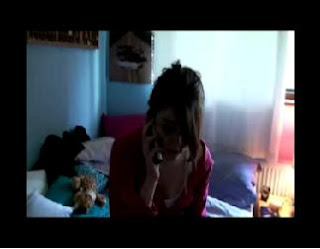
One thriller convention we used was that of enigma, where certain details are left unanswered raising questions and making the audience uneasy. In the first scene of our product the female protagonist character speaks on the phone to someone she knows about her missing daughter. However there are a few issues we created to introduce enigma into our product. The audience cannot hear the voice on the other end; by not adding a second voice off screen to respond to our female protagonist the audience do not know who she is talking to or what the other voice is saying. The audience also don’t know why the girl is missing and this further raises questions and a sense of enigma in our product.
(BELOW: By only giving the audio tone side of the phone call it helps to create mystery and enigma)

Another convention we used which is critical in thrillers is the use of sound. In our product the non-diagetic soundtrack emphasises the sense of mystery surrounding the story. The quiet piano piece loops throughout our titles and the first scene. The use of such quiet music is effective in creating suspense and goes in contrast with the change in music in our second scene. At the end of the first scene the quiet piano loop is promptly stopped and meets a booming crescendo and this initiates the second non-diagetic soundtrack which runs through our second scene. This non-diagetic soundtrack has a much faster tempo and has thicker instrumentation to demonstrate the difference between the two scenes and the large jump between the slow paced first scene and the fast paced second scene with the male protagonist. Another use of sound outside of the non-diagetic soundtrack is the raised volume of the passing trains in our second scene. The trains passing by are made even louder to emphasise their power and also to scare the audience as the trains speed past. This use of sound within non-diagetic soundtracks and amplification is a convention we demonstrated in our product which is common in thrillers.
(BELOW: My emphasising the sound of the train speeding past it made it seem much more dangerous and threatening)

(BELOW: My emphasising the sound of the train speeding past it made it seem much more dangerous and threatening)

Another convention of thrillers which we incorporated was use of editing. Editing can be used to set the pace of a scene by the amount of cuts used and the time in which they last on screen. In terms of pace in our first scene is very different from the pace is the second scene and this has been achieved through editing. The first scene only has three shots and this lack of shot variety creates a slow pace and there is only two transitions in the whole scene. This helps to create a slow and thought-provoking mood. However in contrast the second scene uses many more cuts and the shots last much shorter amounts of time enabling us to create a faster pace and tense atmosphere for the audience which is a typical convention for a thriller.
(BELOW: In our first scene there are only three shots and this establishes a very slow pace)

(BELOW: In our first scene there are only three shots and this establishes a very slow pace)

Another convention typical of many thriller is the 3 stages of a narrative; normality, disruption and resolution. However thrillers sometimes do not include a beginning stage of normality and jump straight into a disruption in order to create immediate tension. An example of this could be the thriller “Vertigo” in which the film begins with a fast paced chase sequence in which the male protagonist nearly dies when hanging from the guttering of a roof. We decided to follow this example and experiment with the 3 stage narrative. Instead of a beginning, our product delves straight into disruption by lumbering the audience with questions that are raised such as why is the girl missing? And who is the male looking for her? This use of and experimentation of the 3 stages of narrative is a typical convention used in our product.
(BELOW: The piece starts with the disruption, the missing girl instead of having a non-problematic beginning)

(BELOW: The piece starts with the disruption, the missing girl instead of having a non-problematic beginning)
In our product another convention we have used lies in the realms of mise en scene is the use of lighting. Lighting can help get across the sinister mood in a thriller and by having variations of lighting in a product it’s easy to create a variation of moods. In the first scene very dark, low key lighting is used in scene and the only direct, on screen light is a dim desk lamp. This use of minimal light helps to depict the sad and mysterious mood conventional of thrillers for example the opening scene of “The Interpreter” uses minimal light to show the secret infiltration by the female protagonist into the government building at night time.
(BELOW: Use of very dark, low-key lighting to depict the mood)

(BELOW: Use of very dark, low-key lighting to depict the mood)

Another convention of thrillers which we incorporated into our product was the use of camerawork. In our first scene the camera uses close up shots focusing on the female protagonist whilst she speaks on the phone. This close up is used to make the scene very personal and very close to the character, as if we are invited into her world. Whereas in the second scene within the variety of shots some long shots are used and these help to emphasise the distance he has had to travel and the enormity of his mission. Examples of very personal close up’s would be from the title sequence in Hitchcock’s film “Vertigo”, even though these are extreme close ups the same effect is created of getting very close and personal to the characters.
(BELOW: an example of an extreme close up from our product, these close ups are used to get very personal with the character in shot, in this case the male protagonist)

(BELOW: an example of an extreme close up from our product, these close ups are used to get very personal with the character in shot, in this case the male protagonist)

One of the vital elements to a thriller is setting which falls into the area of cinematography knows as mise en scene. We incorporated this by using a girl’s bedroom for our first scene. We used the bedroom so it can establish the female’s character and helps to establish what might have happened to the grieving female. However we used a train station for our second scene as this went very against our previous location and showed a definite difference between the two scenes. We specifically chose this station as it is usually deserted and would add a sinister, lonely aspect to the piece.
(BELOW: By using a girls bedroom and a train station the two juxtapose against each other. By having radical differences in location we can show the radical differences between the characters)

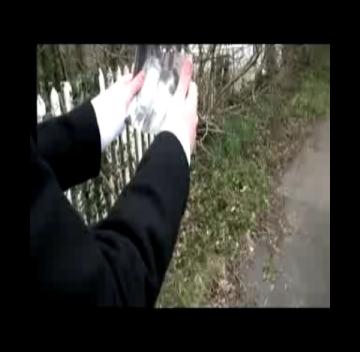
Another element from mise en scene that is vital for thrillers is costume and what they depict about a certain character. For our female protagonist we chose innocent and feminine colours e.g. pink. This was used to let the audience know she wasn’t a threat and that we required the audience to have sympathy with her. Therefore by using feminine, non-threatening colours we managed to communicate the female character across as a character to trust and relate to innocence. Similarly we used a black long coat for the male protagonist as black is seen stereotypically masculine and adds a sense of mystery and enigma to his character as seen below.


The theme of our product also had to suit a thriller because certain tweaks in a storyline or overall theme can change the product over in genre. For example if what had taken the missing girl was some kind of monster then the product would fall into horror however because we are lead to believe the girl has gone missing due to actions by man and non-supernatural reasons the piece fits into a thriller.
(BELOW: At this point where the reason for the girl's disappearance is unknown the product could fall into horror if the reason was supernatural but because it is due to action of man it still keeps to the thriller genre)
In conclusion after in depth research of the conventions of thrillers from real media products we used many of them to enable to create the aspects of the thriller genre in our product.
Q2 - How does your media product represent particular social groups?
In our media product the two characters are of many differences and these differences belong to different social groups such as gender. In our product these two characters are represented very differently according to their different social groups.
· In our product the female protagonist is represented quite stereotypically; a woman in distress. In the scene she is crying over her missing child and this could be seen a very feminine characteristic to let out emotions. Whereas a male character in this position may try hold in emotions instead of crying as crying is often seen a much more feminine quality.


· Our female protagonist also is wearing pink which is a colour which commonly has connotations of femininity.
· We used this stereotype because it was much easier for the audience to grasp what was happening so early on in the piece.
· By using aspects of mise en scene, such as the pink costume and crying body language, the audience can immediately sympathise with the weeping female protagonist.
· Within camerawork the first shot of the piece, a high angle, looks down upon the female and this connotes a sense of venerability and weakness in a time of sadness.
However the male protagonist character is represented differently as he is shown from the different aspect of gender.
· His costume is black and this dark attire is often associated with detectives or the police which usually has connotations of masculinity. The black also is used to denote mystery and doesn’t reveal anything about his personality only that he is a detective.


· Within camerawork there are several low angle shots where the audience watch the male protagonist dash down the stairs. By using a low angle shot his character seems much more dominant and powerful.
· The male protagonist says no dialogue and this very much is in contrast to the female in the previous scene who spoke large amounts. These two opposites in the amount of sound can both show how gender is represented differently. The male protagonist is represented as a strong, silent type and this is often associated with masculinity. Whereas the female protagonist is very talkative and this talkative feature is often associated with a stereotype of femininity.
These stereotypes were used so that in the brief time that they are on screen the audience could immediately gain an understanding of the characters via the stereotypes they already know. For the female protagonist using of feminine colours and body language, the audience can immediately infer she is a female in distress over the loss of someone close to her. However with the male protagonist even though he doesn’t speak, his costume and lack of speech add an air of mystery surrounding him and combined with the low angle shots display a sense of power within his masculinity.
Q3 - What kind of media institution might distribute your media product and why?
In the current world of cinema distribution contains a massive choice for new filmmakers. Whereas before films were often distributed to only cinema films can now be distributed via many different platforms such as cinema, DVD/Video, downloads, portable devices, specific TV film channels, film festivals, video-sharing websites such as YouTube. For our product what would be interesting, to grab the largest spectrum of audience, would be to create a multi-platform distribution meaning it is not just released via one medium but many.

Another platform that could be used would be distribution via free download meaning that the film could go viral. Many products given away by Internet downloads are usually managed through mediums such as blogs. An example of giving away free downloads on a blog to gain a audience would be the TRANSPARENT blog (link below) even though TRANSPARENT deals with music distribution it still works on the same basis; allowing an audience to download and use a product for free via a blog.
 This has advantages as it could pass round very quickly and an audience may be more willing to watch it if it’s for free. Even though this would make no profit it would be the fastest, easiest and cheapest way to distribute the film. However the film would needed to be certificated by film rating institutions such as the BBFC (their certifications of the left and link below) and if the film was certificated 15, which considering its content and theme it would probably achieve, it would be hard to enforce the certificate if the product was to go viral as anyone would be able to watch it and could be unsuitable if younger audiences watched it.

However one other platform that our product could be distributed to could be specific film channels such as FILM4 (link below) that usually focus on certain seasons for film e.g. Horror season, Comedy Season and could incorporate our product into one of their film seasons. This means that if featured in a Thriller Season our product would be instantly met by the appropriately targeted audience of thriller fans. However the product is shown would only be shown once and there wouldn’t be the choice for the audience to watch the product again and this doesn’t allow our audience complete, on demand access to the product.
In conclusion the most exciting and beneficial way of distributing our product would be via free downloads where the audience can download the film for free onto their PC or portable device. This is evidently cheaper and puts the power within the film makers which is an example of democratization.
“DUKE OF YORK” HOMEPAGE www.picturehouses.co.uk/cinema/Duke_Of_Yorks/
“BBFC” HOMEPAGE http://www.bbfc.co.uk/
“FILM4” HOMEPAGE www.film4.com
Q4 - Who would be the audience for your media product?
To find out what groups of people would go to see our film I had to show my thriller opening to a wide range of people in order to find out the audience our film would interest. The range had to cover different ages and genders in order to find what specific audience would go to see my thriller.
I showed my opening to 10 people, 5 male and 5 female. Within each gender the ages varied. The youngest person was 13 and the eldest person was 83. I showed the opening to the 10 people individually and gave them each an answer sheet in which they could rate the opening out of 5 and also write further comments. Once all 10 people had watched the opening I could gain an understanding for the audience of our thriller. A link to download a copy of the answer sheet is at the bottom of this question.
· From the answer sheets 6 out of 10 people rated the opening with the full 5 out of 5. Four out of these 6 were male and the other two were female. This shows evidence that the thriller may be aimed at a much more male audience.
· When asked afterwards if they would watch the whole thriller 7 out of 10 people said they would. Out of these 7 people 6 of them were under the age of 40. This is evidence to prove that my thriller is attracting a younger audience under 40.
· When afterwards asked what other thrillers they had liked previously the answers were varied. Recent thriller titles such as “Inception” appeared in the survey and older thrillers such as “Jaws” and “Vertigo” also were referred to and this shows me that my audience mostly have a wide knowledge of thrillers dating from different times in thriller history. However 3 out of the 10 participants didn’t know what a thriller was a needed the term explained. This shows that thrillers were not the most common favourite for everyone in my survey but however there was a wide range of thriller knowledge in those who did answer.
From these questions I have gathered that our audience would predominantly be male as more males than females rated the film as something they’d want to watch. The age gap would be between the ages of 13 and 40 as more participants between these brackets enjoyed the film and wanted to watch more. Combined I have decided the audience for my thriller would predominantly be males between the ages of 13 and 40.
LINK TO DOWNLOAD A BLANK COPY OF ANSWER SHEET http://www.zshare.net/download/889093210bdcac06/
LINK TO DOWNLOAD AN EXAMPLE OF A FILLED IN ANSWER SHEET http://www.zshare.net/image/8890943829f46cd5/
Q5 - How did you attract/address your audience?
· The story of our product captured some of our audience’s attention and most were intrigued by the story. There were mixed views on some of the use of enigma in the thriller. When asked about the first scene where only one side of the phone conversation is heard 7 out of 10 people said they thought this helped to create suspense and enigma however the remaining 3 of out 10 people found this worked in the opposite way and was in fact just annoying that the audience could only hear one side of the conversation. The participants were asked if they could guess what was going to happen in the rest of the thriller or if they had any clues as to how it may resolve. 2 out of 10 people in fact thought that the male protagonist was the villain or antagonist and 2 others out of the 10 people thought the two scenes seemed unrelated.
· When asked to comment on camera work our participants all agreed that the second scene had stronger use of camerawork and was much more exciting for the viewer to watch. When asked whether they thought the pace of the second scene was faster all agreed and that this was down to the variety of shots and more cuts. Many agreed that the use of low angles and pans made the male protagonist seems quite threatening and powerful enticing them into the excitement in the piece.
(BELOW: AN EXAMPLE OF A PARTICULARLY EFFECTIVE LOW ANGLE SHOT THAT COMMUNICATES THE MALE PROTAGONISTS POWER)

· However over half the participants in the survey though the idea of a missing child was unoriginal and that from this theme the plot was semi-predictable.
· When commenting on the use of sound all 10 people thought that the sound worked effectively to create suspense and to set the mood for the film. Particular interest was shown in the use of the train station speaking time table at the end. More than half the participants thought the combination of the sound of the electronic voice and the cut to black set the mood for the thriller and seemed very sinister and proposed dark themes or moods in the film alongside the non-diagetic soundtrack throughout.
· The use of mise en scene also attracted our audience especially in terms of lighting. Within the first scene the use of dark lighting was commented on many times. The use of the dark lighting helps to set the gloomy tone of the first scene and the lighting also manages to depict the themes as well as one that is quite dark. Costume; another element of mise en scene, was also regularly commented on and the costume for both characters, the stereotypical pink for the female and black long coat for the male, suggested the differences between them and the audience often wanted to know more about them as characters. The black coat was commented on as being particularly effective in creating mystery and suspense around the male protagonist.
(BELOW: In this first scene the mise en scene element of lighting is helped to communicate the mood of the product, dark.)

(BELOW: In this first scene the mise en scene element of lighting is helped to communicate the mood of the product, dark.)

From asking my participants to comment on various aspects of our product I managed to understand what qualities attract our audience to the film. Various aspects of mise en scene such as costume and lighting work effectively in capturing and intriguing the audience however the story and narrative sometimes seems too unoriginal.
Q6 - What have you learnt about the technologies from the process of constructing this product?
Click the link below to hear my audio commentary answer. It will ask you if you want to download the mp3 file containing the answer. The download is free.
CLICK HERE
Below is a written transcript of my answer on the file...
Q6 - What have you learnt about the technologies from the process of constructing this product?
Click the link below to hear my audio commentary answer. It will ask you if you want to download the mp3 file containing the answer. The download is free.
CLICK HERE
Below is a written transcript of my answer on the file...
Over the course of making this product I have learnt a lot about technologies used in film making. Some of which built upon knowledge I already knew from previous tasks and some new information I learnt when taking on this thriller opening.
In terms of the camerawork I have learnt that along with the camera, the correct equipment is always needed for a successful shot.
For example when filming on the station our correct use of a tripod enabled us to gain a steady shot as the train sped past our male protagonist. If we had attempted to do this shot with no tripod and trying the shot handheld or Steadicam the shot would most likely have been ruined by shaking or turning.
I also learnt significant amounts about use of shots and the important role they play. Varying in size or angles and how they can connote different things to an audience.
For example in our second scene as we follow the male protagonist we decided to use a variety of shots, from high angles to low angle shots and from extreme close ups to long shots. All of these combined managed to give an interesting perception of the male character and specific low angles managed to create the sense of power surrounding the male protagonist.
I have also learnt much more on editing building on my very basic knowledge I had before. I have learnt the significance of match on action and the time it can take to get a specific example right.
Our second scene following the male protagonist is a specific example of where match on action is used many times to create a sense of pace. My group and I took large amounts of time making sure this all fitted together and created the sense of pace we wanted.
I also learnt about creating pace via editing which was an essential convention needed for our thriller. By using a large variety of straight cuts I learnt I could create faster pace for this scene in which we follow the male protagonist through a train station.
Another technique I learnt and enforced in our product was ellipsis. The scene through the train station could all have been done in real time but would have been much more boring and would have had very little pace but by shortening shots and using more cuts I enabled us to use ellipsis to shorten time.
In conclusion I learnt many things from the production of our thriller in terms of camerawork and editing and all of which were used effectively in our piece to create a successful thriller.
Q7 - Looking back at your preliminary task, what do you feel you have learned in the progression from it to the full product?



GEORGE
Over the course of producing two media product I think my progress has dramatically improved since my preliminary task in terms of camerawork, sound, editing, continuity editing and also the ability to create a story or plot and characters.
In terms of camera work in our preliminary we were very basic. We included some close ups, some long shots but there was little variety in the shot types. However in our thriller there is a larger variety of shots such as High angles, low angles, close ups, long shots and then some new shots which we hadn’t tried out before such as an over the shoulder shot or an extreme close up shot. This demonstrates not only our widening of shot variety but also our shot experimentation as well.
(BELOW: An example of a high angle shot which we barley included in our preliminary. This is an example of us expanding our variety of shots.)
In the area of sound I also developed my abilities. In our prelim we did think considerably about the non-diagetic soundtrack and what would suite the piece but however we thought little about other sound outside of a non-diagetic soundtrack. In our thriller opening we still focused a lot of attention on our non-diagetic soundtrack once again so it could communicate the right mood for the piece but we also worked on other non-diagetic sounds as well. At the very end of the first scene as our female protagonist puts down the phone the audience hear a threatening boom initiating the title sequence. Non-diagetic sound effects like this can add a lot more tension to the piece and remind the audience of previous thrillers they may have seen before.
(BELOW: The point in which we initiate the threatening non-diagetic "boom" sound effect which was something that we had not used in our preliminary)
We also decided to get sounds that were specific to the area we were in for our shits. For example when we were in the train station we recorded a “Help Point” machine reading out an automatic list of what trains were coming. This is an everyday sound at any train station but put over black credits and a sinister non-diagetic soundtrack and it creates a very eerie effect typical of thrillers.
(BELOW: using the diagetic sound of the train "Help point" over the top of the black credits we managed to create an eerie thriller effect.)
In terms of editing I think I vastly improved as before hand in our prelim very little tension was built as the use of editing didn’t help to create pace of suspense. Whereas in our thriller opening I made sure that our second scene could create tension and fast pace by use of many more straight cuts as he dashes through the train station.
(BELOW: one of our many shots used in our second scene to emphasise the pace as the male protagonist dashes through the station.)
Within the same realm of editing I also experimented with titling. In our preliminary we use any titling at all whereas in our thriller a lot of time was spent choosing the right titles for our thriller. We decided to use a black background and white writing because it seemed quite incongruous with the name “Sunlight”. “Sunlight” would normally connote feelings of happiness and usually seems quite bright and jolly however because we were making a thriller about a kidnapping we needed the titles to communicate this.
(BELOW: we experimented using our titling making sure it still matched the theme of the thriller)

I think I have also vastly improved in terms of continuity editing as well. In our preliminary our continuity editing in places was rather weak; the location changed half way through and changed again later on. However In this thriller opening we have kept all locations, props and costume consistent.
(BELOW: for the second scene we made sure we used the same location all the way through as not to break continuity editing as we had done previously in our preliminary.)

Also within continuity editing I think I have been experimental in terms of continuity editing techniques such as an eye line match which we incorporated into our thriller opening as the male protagonist looks at the girl of the missing girl. Whereas in our preliminary we used no conventions of continuity editing such as an eye line match or any match on action which we have now used in our thriller opening especially match on action.
(BELOW: our eye line match which was a technique we hadn't used previously in our prelim.)

I also think I have learnt much more about building a story or plot since my preliminary. Whereas in our preliminary we entered at the middle of a story, in my thriller opening we start the beginning and building a story around it. Also I think our thriller’s story line is much more unpredictable as to what might happen whereas I feel our preliminary story line was quite cliche and quite obvious as to what was going to happen. I think this sense of unpredictability in our thriller story line is a step up from a predictable plot in our preliminary.
(BELOW: The first scene raises a lot of questions a displays that the rest of the films plot may be quite unpredictable.)

In terms of character building I think our thriller has been much more successful and there is a lot more I have learnt about representing our characters. Whereas in our preliminary our characters seemed very basic two dimensional protagonist and antagonist I think our thriller characters are much more detailed and make our audience think a bit more. Our male protagonist is not made clearly as to whether he actually is a protagonist or antagonist and this enigma surrounding him has been one of the things I have learnt about building characters for thrillers.
(BELOW: I developed the character of the male protagonist so that the audience have to think deeply as to whether he is good or bad, whether he is the protagonist or antagonist.)

In conclusion I have learnt a lot since our original preliminary piece which has been shown in my thriller opening. I have learnt a lot from many different areas such as camerawork, editing and the contents of the story. I think many of these abilities I have learnt have been displayed in my thriller opening and show the dramatic amount I have learnt since my original preliminary.
GEORGE


